
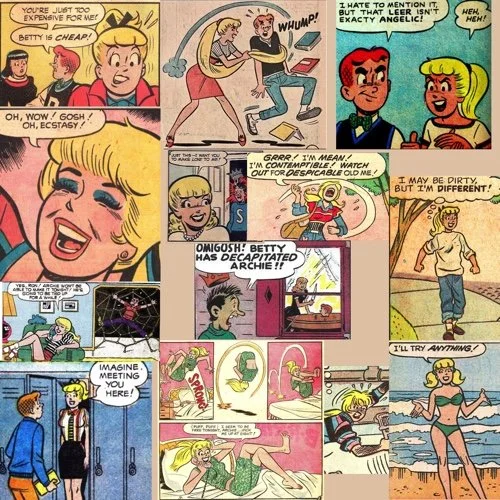
Canon Or Continuity?
This is mainly going to focus on the Archie character (Betty in particular) with a little bit of theology tossed in at the end. I’ll put a break in the text and clearly label the theology portion so those of you disinterested in that topic can skip reading to the end.*
. . .
Betty Cooper:
Shy girl next door pining away for Archie Andrews?
Wholesome Christian teen with a healthy moral attitude?
Tomboy star athlete who can fix cars?
Insanely jealous psychotic homicidal minx?
You decide!
While all the Archie characters are all over the map in terms of personality traits, by far Betty Cooper is the most extreme of the bunch. For example, it’s canon that she’s…
…disguised herself as a male to sexually assault fellow female students.
…twice tried to kill Archie and come close enough to put him in the hospital.
…twice tied Archie up and ravaged him on camera to taunt Veronica.
…made a deal with the devil (he backed out in a panic!).
…been possessed by a demon (yeah, sure; nice alibi, kid).
…suffered repeated head trauma sufficient to induce amnesia.
Yeah, she’s the girl next door…
…if next door is the Spahn Ranch.
All of which illustrates a problem in story telling by diverse hands, an awful lot of stuff is canon because it suits the needs of a particular story, but precious little of it stays in continuity.
(One of the great things about being on the original Sunbow team behind Transformers and G.I. Joe was that we could change or add things with impunity since there was no long history to contradict. “Hey, is Roadblock a Rhodes scholar? Hmph, he is now…”)
While Marvel Comics put the heavy emphasis on continuity, earlier popular fiction franchises also found fans obsessed with keeping everything in strict order.
Sherlock Holmes springs to mind, but in some cases such as the Cthulhu mythos, fans created a continuity that didn’t exist in the original texts.
It depends on whether one looks at a series as telling one long, complex story or whether it provides a series of stock players who can be plugged into a variety of roles in a variety of stories, changing their particulars according to artistic whim and editorial fiat.
Archie Andrews is a terrible klutz…except when he’s a star athlete.
Veronica Lodge is a selfish, narcissistic brat…except when she’s standing up for people.
Jughead Jones is an asexual dope dealing sociopath…except when he’s…well…he’s always an asexual dope dealing sociopath (canon, folks, don’t make me produce receipts).
The point is, in the Archieverse there’s never a single correct way to view the characters or their stories.
As Kipling once penned:
There are nine and ninety ways
Of constructing tribal lays
And every single one of them is right.
. . .
Here comes the theology: So immediately the question comes, are the stories in the Bible canon or continuity?
It’s really hard to argue continuity. Anyone who claims there are no contradictions in the Bible needs to go through such logic contortions they resemble the proverbial Indian rubber man. Anyone who claims there are thousands of fulfilled prophecies must deliberately overlook clearly failed prophetic utterances while claiming any prior mention of a person / place / thing is a prophecy is said person / place / thing is mentioned again.
Maybe we’re looking at scripture the wrong way.
Maybe instead of thinking of it as a single cohesive story it’s time we start seeing it as a variety of stories and writings from different points of view, often by people who disagreed with one another over the meaning of the very texts they worked on.
When we try applying continuity to the Archieverse, it quickly falls apart. The positives to be gleaned from it get lost in a maze of contradictions. Better instead to go with the flow, to recognize that what is established as cold, hard fact in this story doesn’t necessarily apply to the next story --
-- and that doesn’t render either story invalid.
© Buzz Dixon
* Unless you’re masochists, but hey, we don’t discriminate against anyone’s denomination here…
![Battleship [FICTOID]](https://images.squarespace-cdn.com/content/v1/590697e7d1758ec4d7669624/1751259156672-370ZU8BXZUHQJWAC4QCX/FT+311+Battleship+SQR.png)
![Did They Have Rainbows Over Dachau? [FICTOID]](https://images.squarespace-cdn.com/content/v1/590697e7d1758ec4d7669624/1751258931891-6BY4CMRS41V6JLX0F5OY/FT+310+Did+They+Have+A+Rainbow+Over+Dachau+SQR.png)