Punching Up, Punching Down, Punching Out
I haven’t seen the new Chevy Chase documentary I’m A Fncking A-Hole (And You’re Not)[1] yet, but then again, does anybody really need to? Chase is one of the most self-evident people on the planet, so self-evident it’s surprising he’s not occupying the White House. As the band Sugarloaf once sang in “Don’t Call Us, We’ll Call You” when asked if they had someone’s number, “We had your number the moment you walked through the door.”
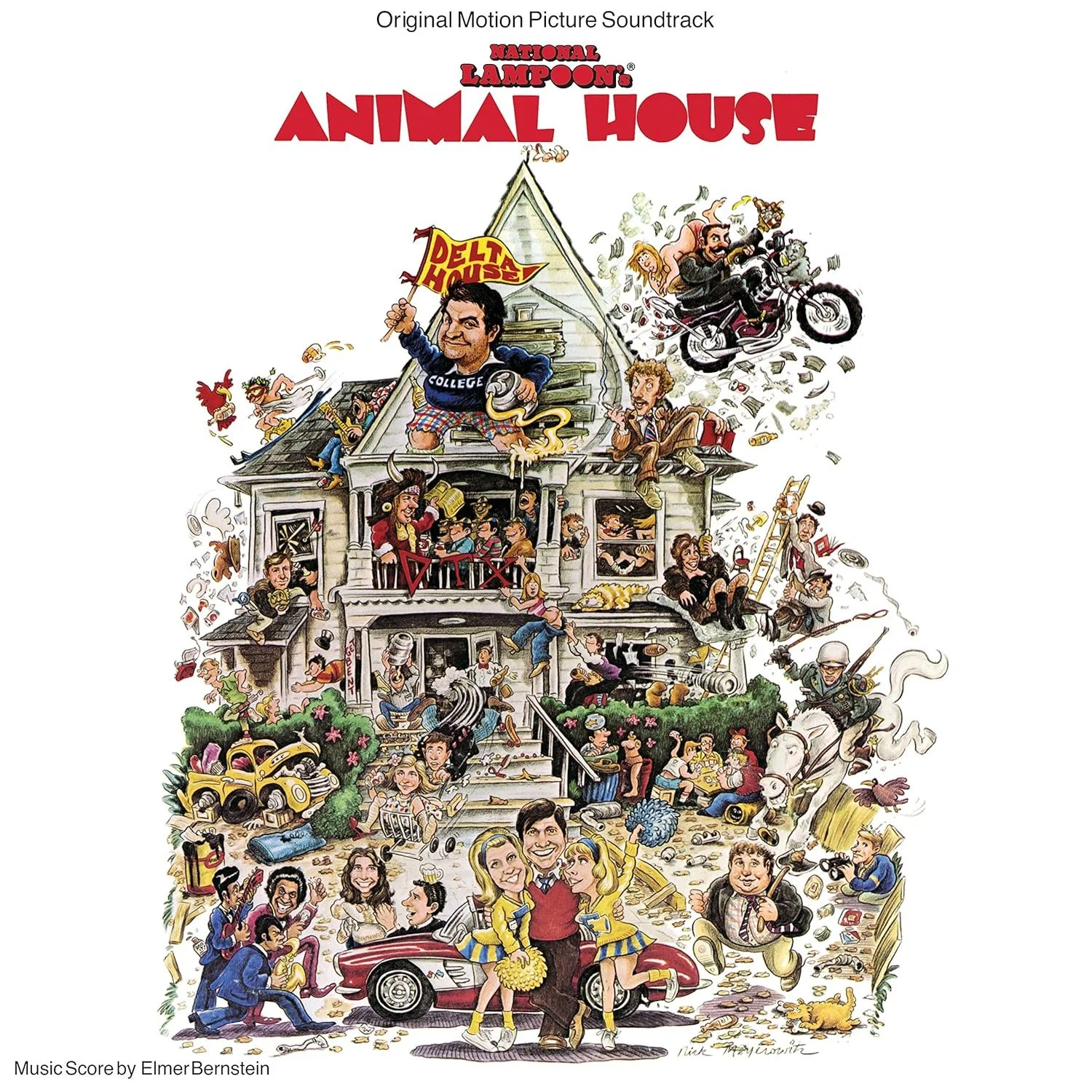
But recently the discussion about Chase overlapped with a reappraisal of National Lampoon’s Animal House. While Chase did not write for NatLamp magazine back in the day[2] he did work on The National Lampoon Radio Hour and their off-Broadway revue, Lemmings before signing on as one of the original Not-Ready-For-Prime-Time players on NBC’s Saturday Night Live[3] and rocketing to stardom.
(Sidebar re National Lampoon before delving into the heart of this post: A spin off from the still existent Harvard Lampoon, NatLamp bears a complicated legacy. Published with high technical and aesthetic standards, NatLamp heartily encouraged a blatant take-no-prisoners policy. Groundbreaking and deliberately offensive, much of their material didn’t age well over the decades. While much remains brilliant and enjoyable to this day, other parts reflect attitudes ethically objectionable even back then still got a pass at the time.)
Though not involved in the NatLamp publication, Chase fit perfectly into the magazine staff’s mindset: Predominantly white privileged male college frat brats with an overpreening sense of superiority and entitlement fueled undying resentment against a world that not only refused to cater to their every whim but demanded accountability for their behavior.
As such, National Lampoon’s Animal House is the perfect distillation of that ethos.
What surprised me was the realization it also served as a prediction for where this country was heading.
. . .
Hubris is a tragic flaw that worms its way into all organizations and more than a few individuals. Like a recurring infection, it can prove fatal without an effective immune system to counter it.
After organized religions, governments historically are more susceptible to hubris than any other human endeavor.
Especially elites in those governments.
In the 1950s the US patted itself on the back when the CIA thwarted at Communist insurgency in the Philippines.///[4]///
Assuming one-size-fits-all when it came to Asian cultures, they applied the same strategy in Vietnam, installing a puppet government and encouraging tactics and strategies that worked with Filipinos but not Vietnamese.
In short order the puppet government -- infected with fatal hubris of their own -- alienated the majority of their population. The US backed them with military might, initially “advisors” but later a combined military force of over 500,000 personnel.
Despite troops in the field reporting the conflict accurately, the US military / political leadership steadfastly refused to listen to any contrary data, continuously doing exactly the wrong things to win the Vietnamese people over.
Fish rot from the head down, and John F. Kennedy – a Harvard grad – backed his Secretary of Defense Robert MacNamara – another Harvard Grad – who steadfastly refused to consider any facts contrary to his grand strategy.
The military under him responded with inflated and blatantly false official reports, claiming nonexistent victories and territorial control.
Small wonder the Vietnamese eventually won through sheer persistence, forcing America to realize all their efforts at the cost of millions of Vietnamese and over 50,000 Americans lives had always been futile from the beginning.
Hubris. The inability to recognize the possibility one might be wrong coupled with a false sense of righteousness in one’s goals.
And we repeated the mistake just a few decades later, plunging into Iraq and Afghanistan to retaliate against a small terrorist organization that lacked widespread support, turning them into a widely back non-centralized movement in the process.
Hubris. The belief one’s way of doing things is the only way and anyone not doing it your way is a fool.
Hubris, thy name is NatLamp.
. . .
Now, I’m not making a jump connecting the magazine and staff directly to the turmoil America is currently going through, but I will say the patterns are identical, especially in Animal House.
If the JFK administration represented the so-called “best and brightest” falling prey to hubris, and the GWBush administration the corresponding “worst and stupidest” (to quote a famous Doonesbury punchline), then the current administration is nothing but hubris, no hint of talent and ability among them.
How did they wind up running the country?
Well, let’s take a look at Animal House…
One of the taglines for the movie was “It was the Deltas against the rule. The rules lost.”
Let’s refresh the loose plot of the movie. The focal point character is Larry "Pinto" Kroger, a college freshman seeking to join a fraternity. Rejected along with fellow freshman Kent "Flounder" Dorfman by the upscale Omega fraternity --
Hold on, let’s not overlook some incipient racism: Kroger and Dorfman are shunted off by the ever so polite yet hypocritical Omegas, they sent to sit with another freshman, a foreign student wearing a turban. Kroger and Dorfman reject him as well and do not invite him along when they go to the Delta fraternity, the infamous “animal house” thus demonstrating themselves to be no better than the Omegas.
The movie wants to paint the Deltas as misunderstood free spirits persecuted by the Omegas, the school, and society at large. They come across as not merely anarchistic but disruptive and dangerous. Their pranks, intentional or not, inflict harm and damage on others up to and including accidentally killing a horse favored by one of the Omegas.
They not only feel themselves entitled to engage in such behavior due to their status as privileged white college frat boys, but them openly embrace it and celebrate it. The entire thrust of the movie is for us to side with them, agree their bullying and abuse and acceptable behaviors even when directed at helpless, harmless, innocent victims.
There’s no dodging that. Compare Animal House with the nearest previous cinematic equivalent, the Marx Brothers’ Horse Feathers. While Groucho as the school dean often perplexes and frustrates his professors, he never causes harm to them or their students. His motives in the film are to help his college’s team by recruiting two professional football players (mistakenly ending up with Chico and Harpo, of course) and by preventing gamblers from rigging the game.
Conversely, the Deltas lack any motivation beyond pure self-gratification at the expense of others. They treat women as objects of desire to be acquired, not fellow human beings worthy of respect and common decency, with goals and ambitions of their own.
One of the big set pieces in the movie is when Eric "Otter" Stratton, an older Delta, convinces Kroger and Dorfman to accompany him and his best friend Donald "Boon" Schoenstein on a road trip, virtually commandeering the car Dorfman borrowed from his brother for the week.
Stratton sets out to score dates for them by going to a nearby women’s college where a student was recently killed in an accident. Passing himself as her boyfriend to her sorority sisters, he gets four of them to accompany the Deltas to a roadhouse with a predominantly African-American clientele. Informed they’re not wanted there, the four Deltas abandon their dates and flee the scene, damaging Dorfman’s car and others in the process.
Let’s not overlook that racism, either: The movie clearly wants us to laugh at the predicament of four innocent victims being left among a rough African-American crowd.[5]. That the makers of Animal House thought this even remotely funny reflects on their sexism and racism and their willingness to victimize anyone and everyone different from them.
While Animal House points out duplicitous and overbearing behavior on the part of the college dean and the Omegas, including open collusion with the local crime lord[6], the Deltas do nothing to expose or stop this wrongdoing.
Indeed the Deltas get hoisted on their own petard when they steal the wrong answers to the midterm exam, failing their courses and earning expulsion from the school despite being warned repeatedly this would be an outcome of their continued bad behavior.
In retaliation they hijack the homecoming parade, sending vehicles and floats careening into the crowd of innocent spectators including young children. John "Bluto" Blutarsky kidnaps a rival’s girlfriend whom he’s been lusting after for the entire movie despite her constantly rejecting him -- but that’s okay because she changes her mind and falls in love with him as soon as he drives her out of town.
The capper to all this are the titles at the end that explain what happened to all the major characters. It’s one of the few genuinely funny things in the movie that has aged well, because we’ve only seen this hypocrisy and elitism play out in exactly the same manner in real life.
Kroger became an editor for National Lampoon.
Dorfman became a sensitivity trainer.
Stratton became a Beverly Hills gynecologist.
Blutarsky and the co-ed he kidnapped became Senator & Mrs. Blutarsky.
They emerge victorious in the end not because of anything they did, but because despite their rivalry with the Omegas, they were plugged into an elite social network that guaranteed they would never fail, never be held accountable.
. . .
Yes, comedies work on absurdity and exaggeration, but when you look at the great comedies and comedians of the past -- from the silent clowns like Chaplin and Keaton to the madcap comedies of the Marx Brothers and W.C. Fields to the slapstick of Laurel & Hardy and the Three Stooges -- you see common threads: They did no harm to those weaker or worse off than them, their characters strove to achieve something, and their worst punishments were often self-inflicted through their own stupidity.
Animal House was created by relatively young upper class privileged white elites with little life experience beyond college and satirical comedy.
Blazing Saddles was created by a Borscht Belt comic who began his apprenticeship at age 16 with a brief hiatus while he served in WWII and an African-American comedian who grew up in an epically dysfunctional and abusive impoverished home environment.[7]
Animal House always punches down, mocking everyone the Deltas considered as inferiors.
Blazing Saddles always punches up, uniting oppressed people against their oppressor -- who a hundred years later would be likely be a Delta.
You never age well punching down.
You always age well punching up.
© Buzz Dixon
[1] Satire, folks.
[2] I did!
[3] Originally titled just plain ol’ NBC’s Saturday Night.
[4] Primarily by backing a Filipino leader who knew his people and culture well, and possessed the wisdom and patience to deescalate the confrontation instead of trying to batter the insurgency into submission.
[5] Fortunately someone involved either in the production or at the studio showed the common sense / common decency to include a scene of the angry but unharmed young women walking back to their school.
[6] A subplot which makes no sense and adds nothing to the movie and provides no payoff other than a chance to dislike the dean more. At least in Horse Feathers the Marx Brothers were trying to stop outside interference from organized crime trying to rig the outcome of the game.
[7] While Richard Pryor originally emulated Bill Cosby’s genre of comedy, he soon struck out on his own, finding his own unique voice. Cosby frequently criticized him for his outrageously offensive takes on social ills. Guess who got the last laugh?
![Family Matters [FICTOID]](https://images.squarespace-cdn.com/content/v1/590697e7d1758ec4d7669624/1746339048797-5H6MMMHFJG835W74X638/FT+302+Family+Matters+SQR.jpg)