
Everything’s Archie (1 of 5)
Caveat: While I’m a big fan of classic Archie comics, I’ve not kept up with them in the modern, more realistically drawn era. Basically I’m setting a cut off date of December 31st 2000 for this critique. I know since then the Archie characters have arced off on a variety of tangents, but I’m primarily sticking to the first four decades, 1941 to 1980.
. . .
Two things greatly impacted American culture in December of 1941.
The first was Japan’s sneak attack on Pearl Harbor.
The second was the arrival of Archie Andrews in Pep Comics #22.
Japan’s impact proved more immediate in the short term but unless one wants to count manga and anime, Archie’s is more long lasting.
It’s key to note there’s virtually no continuity of character — much less story — in the Archieverse. In some Archie’s a klutz who fails at everything, in others he’s an ace athlete and an accomplished musician.
The Archie characters are like Bugs Bunny and other Looney Tunes characters: More actors in stories where they play a variety of roles than actual characters themselves. They start from basic archetypes but off of that can build an infinite number of variations.
Just as Bugs can be a woodland rabbit in one cartoon, a world traveler in another, and a Hollywood movie star in a third, Archie, Betty, Veronica, Jughead, and all the rest can fulfil a variety of roles while adhering to basic character types.
There is canon in the Archieverse, but no continuity.
. . .
I was introduced to the Archieverse via Little Archie, a truly top notch kids comic drawn by Bob Bolling.* While aware of the “grown up” Archie titles, pre-adolescent Buzzy boy didn’t care for all that “mushy stuff.” Little Archie offered fun tales ranging from Our Gang-like stories to Little Archie encountering spies and dinosaurs and mad scientists.
It even offered heartbreaking stories such as the one about a pet cat morning the loss of her kittens.
While I encountered and occasionally read Archie comics in my teen years, I didn’t seek them out but rather found them in doctor’s waiting rooms and friends’ houses.
It wasn’t until my mid-twenties that I became aware of the enormous contributions of the tremendous contributions of artists Bob Montana, Dan DeCarlo, and Stan Goldberg.
The Archies comics line generates an enormous amount of material, enough to film numerous digest / anthologies / collections of up to 1,000 pages each.
It’s fascinating to trace the growth of not just Archie et al as characters but the growth of the company and more importantly, the growth of its influence on American culture, particularly among teens and young adults.
The cultural aspect is especially interesting. While there had been teenage characters in pop culture before (the novel Seventeen by Booth Tarkington in 1916, the comic strip Harold Teen by Carl Ed in 1919, the Andy Hardy movie series that started in 1937, among others), Archie caught a cultural groundswell at precisely the right moment and rode it to dominance over the next forty years.
Despite its December cover date, Pep Comics #22 probably hit the newsstands sometime in October that year.
Here’s the zeitgeist of the moment: World War Two had been raging for two years and while the U.S. remained officially neutral, there seemed little doubt we’d eventually be dragged into the conflict; the Great Depression ended just as WWII started, and the American economy finally regained its vibrancy; the Depression forced a great many children and teens to work to help their families, giving them a greater sense of independence than many previous generations; Americans’ newfound financial solvency enabled teens to be indulged with more consumer goods ranging from clothing to cars.
Archie tapped into this. In the first story we’re introduced to him, Betty Cooper as the girl next door* who has a crush on him, and Jughead Jones, the obligatory asexual holy fool / wingman.
Drawn by Bob Montana and Vic Bloom, the very first Archie story depicts the characters as in their early teens, with Betty possibly only twelve. They’re kids approaching adulthood but their values and interests are clearly on the young side, even though Archie and Betty clearly crush on each other.
In and of itself, the first story is not remarkable, but Archie and the others soon aged up to mid-to-late teens, enabling Archie to drive (and thus get into even more predicaments). In short order wealthy Veronica Lodge got added to the mix as a rival to Betty and Archie’s primary romantic fixation, soon followed by Reggie Mantle, Archie’s rival (to be fair, Archie is kind of a dick to him at first, thus securing his enmity for generations to come).
By summer of 1942 all the major characters were in place and bouncing off one another in a number of funny, fast-paced stories, many both written and drawn by Montana.
What Montana and the rest of the creative crew at that time got absolutely right was the emotional volitivity of teenagers. They bounced back and forth from one extreme to another, professing undying love one moment followed an instant later by equally intense hatred. The stories were typically silly but in a good way, causing chuckle instead of eyerolls.
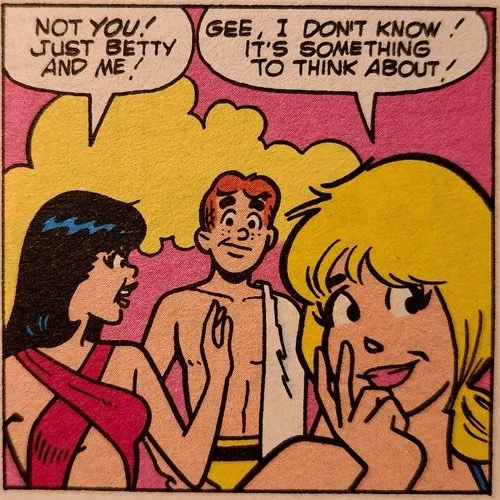
They were also as perverse as fnck. Give adult men an excuse to tell stories about hormonally charged nubile teens and whaddya expect?
© Buzz Dixon
* Veronica is one of Little Archie’s playmates in the series, a clear contradiction to the mainline stories where she moved into town in her late teens. This is what I mean by things being canon but not in continuity.
![Nano Nosed [FICTOID]](https://images.squarespace-cdn.com/content/v1/590697e7d1758ec4d7669624/1746338056748-EPKAZ3RVS7SQFNMF457T/FT+297+Nano+Nosed+SQR.jpg)
![Pray For Annihilation [FICTOID]](https://images.squarespace-cdn.com/content/v1/590697e7d1758ec4d7669624/1746337843369-7E4FJH6NNN93PINXQFST/FT+296+-+Pray+For+Annihilation+SQR.jpg)