
Everything’s Archie (3 of 5)
Before examining Dan DeCarlo’s contribution to the Archiverse, let’s look at comics and teenagers post-WWII, with special attention to Dr. Frederic Wertham and his trash sociology in Seduction Of The Innocent.
While Westerns remained the most popular comics genre well into the 1950s, during WWII they were rivaled by superhero comics. Nazis and Imperial Japanese forces made excellent guilt-free foils for the union suit brigades and they packed the newsstands.
But the Archiverse’s unique blend of characters caught the public fancy, soon spawning scores of imitations, none of which ever managed to catch lighting in the bottle -- or rather, on the page -- the way Archie comics did.
In the aftermath of WWII superhero comics faded fast, titles that once sold millions of copies dropping down to just a few hundred thousand.*
While Westerns held steady, other genres rapidly expanded to fill the void in the market. Archie proved to be the category definer for teen comics just the culture started seeing teens as their own distinct sub-group instead of just adults in waiting.
In addition to the apparently wholesome goings on in Archie and related comics, teens also started reading horror, crime, romance, and science fiction titles in record numbers.
Wertham descended on those genres with a vengeance, claiming them to be the root cause of juvenile delinquency and rising sexual experimentation and drug (i.e., grass) use among teens.
Bullshit, but Wertham’s attack and the subsequent congressional investigation into the impact of comics on teens put a lot the competitors of Archie Comics (the company, not the product) in the crosshairs.
Mind you, during WWII Archie Comics produced as much superhero / horror / crime / etc. comics as their competitors, but Archie hizzowndamself soon became the company’s sacred cash cow.
And since the books ///looked/// wholesome, nobody really checked on how sexually charged they were.
Archie Comics pioneered the drive to establish the Comics Code, pretty much with the deliberate intent to drive competitors William F. Gaines (horror) and Irv Gelson (crime) out of business.
And whaddya know, they succeeded! The Comics Code clamped down on the more sensational titles leaving Archie the dominant force after Westerns.
Well two or more can play that game and soon the comics field and other media were crowded with Archie knockoffs.
The most famous is Max Shulman’s Dobie Gillis stories, first in print then later in film and a long running TV show. A blatant imitation of Archie down to the supporting characters, the Dobie Gillis stories demonstrated how deeply Archie Andrews reached into American culture.
Rival comic book companies began publishing their own knockoffs, none of which ever resonated as deeply with the public as Archie and company. Several companies created titles that while clearly inspired by Archie moved away from purely teen stories into what would be called young adult career stories today.
Dan DeCarlo drew numerous comics of this type from the end of WWII up through the late 1950s when he became almost exclusively associated with Archie.
He also pumped out risqué cartoons for skin mags that featured lots of near to totally nude showgirls.
Giving him the opportunity to define the Archiverse’s new look was the difference between tossing a bullet and firing a bullet.
As good as Bob Montana was, DeCarlo outshone him in all ways, remaining to this day the definitive Archie artist.
He brought a far more intensified energy to the stories, showing characters in dynamic poses even when standing still and putting captivating, nuanced expressions on their faces.
The stories gradually became wilder and more provocative and the relationships even more volatile. Betty and Veronica can be bitter rivals at one moment, absolute besties the next. Archie and Reggie remain rivals but can team up against the girls.
And when the 1960s youth culture arrive in full force? Yowa! Like fighting fire with napalm. The books reached a creative and comic peak they never came close to again.
But lordie, were they dirty. Folks familiar with Archie only through the 1968 Filmation cartoon series have no idea just how raunchy these stories could get. Dan DeCarlo liked drawing pretty young ladies and Archie gave him plenty of opportunities. He leavened the lechery with laughter, but despite the company’s protests that Archie and his friends would perpetually remain 17 year old virgins, he brought sexual obsession to the forefront.
But there was a real world outside the Archiverse, and after briefly flirting with relevancy, the company began backing away from the culture that embraced it.
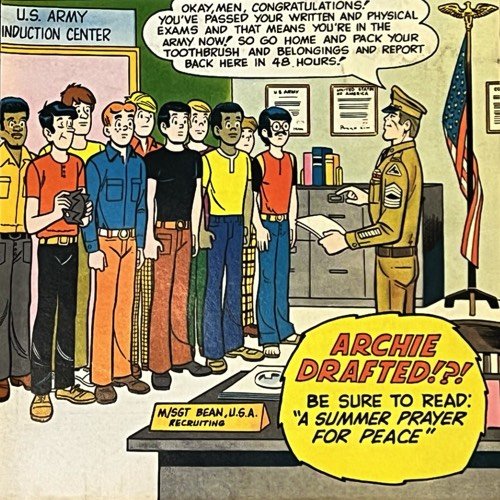
In October 1971 Archie, Reggie, and Jughead were drafted and ordered to report for active duty in 48 hours…
…and then the story line was dropped, never to be referred to again.
Instead, they licensed the Archie characters for the Spire line of Christian comics. Drawn by one of the Archiverse’s stable of artists, Al Hartley, the books looked as professional the mainline stories, but presented a happy-clappy squeaky-clean version of the characters that flew in the face of everything that came before.**
But until they chickened out, Archie Comics headed in a very interesting direction, one that could have kept Archie relevant to contemporary culture. By backing down, they opted to chase trends instead of set them.
Mind you, the material remained as fresh and as funny as before, but they clearly lost their momentum and by the start of the 1980s became more nostalgic than contemporary.***
© Buzz Dixon
* “Just a few hundred thousand” -- ha! Comics publishers today would sell their grandmothers to reach those kinds of numbers.
** We’ll discuss this in relation to Betty and Big Ethel as well as how the mainline comics treated other characters in our next installment.
*** Ironically, during the 1980s Archie’s distinctive bright orange crosshatched hair briefly became fashionable as punk rockers started dyeing and styling their hair in outrageous looks.
![Santa Of The Red Death [FICTOID]](https://images.squarespace-cdn.com/content/v1/590697e7d1758ec4d7669624/1737161708244-GZWH46O36EXJ0528EO2S/FT+2XX+Santa+Of+The+Red+Death+SQR.png)
![Play With Your Cells And Become Your Own Food [FICTOID]](https://images.squarespace-cdn.com/content/v1/590697e7d1758ec4d7669624/1746338226616-2X5B7OB1QMOUTO9U7XHJ/FT+298+298+Play+With+Your+Cells+And+Become+Your+Own+Food+-+AI+generated+-+SQR.jpg)